
Enterprise Cybersecurity Investment Is Accelerating
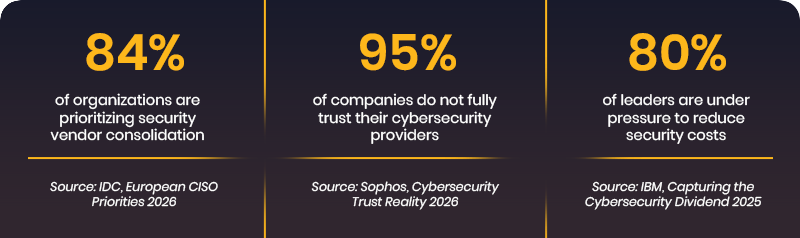
The market signal is clear. Enterprise security budgets are expanding. Gartner forecasts global information security spending will reach $244.2 billion in 2026. Cybersecurity has become a board-level priority, and organizations continue to invest despite ongoing economic pressure.
But strong market demand doesn't automatically translate into predictable revenue. And the gap between the two is where cybersecurity revenue leaks.
This isn't a product problem or a positioning problem. Cybersecurity providers already operate in a market with strong demand and growing buyer urgency. The issue is that the GTM operating model required to convert that urgency into commercial outcomes isn't keeping pace.
Why Cybersecurity GTM Fails Differently
Enterprise cybersecurity GTM has a level of complexity that most traditional GTM models weren't built to support. The buying committee isn't one person or even two—it's typically six: the CISO evaluating risk posture, SOC leadership evaluating detection and operational fit, DevSecOps evaluating implementation friction, IT procurement evaluating TCO and contract structure, legal and compliance evaluating regulatory alignment (NIS2, GDPR, Cyber Resilience Act, FedRAMP), and finance evaluating the ROI justification that goes back to the CFO.
Each of those stakeholders requires a different conversation. Each has different priorities, speaks a different language, and measures success differently. For those delivering enterprise cybersecurity solutions, each additional step creates another opportunity for momentum to slow—and for revenue to leak.
Add to this the technical validation requirement. Unlike most B2B software purchases, enterprise security deals require proof-of-concept execution in the buyer's specific environment—their technology stack, compliance framework, and architecture. Strong cybersecurity pre sales capabilities often determine whether these evaluations build momentum or become bottlenecks. PoC cycles that extend beyond 60–90 days don't just delay revenue; they create opportunities for competitors to gain ground.
And then there's the trust dimension. Cybersecurity buyers aren't just evaluating a product. They're evaluating whether a provider can be trusted in a high-stakes, high-scrutiny environment. That trust is built—or lost—at every touchpoint: how quickly your team responds, how well they understand the customer's environment, and how credibly they navigate technical and compliance conversations.
Taken together, these realities create multiple points where cybersecurity GTM can lose momentum long before a deal is won or lost. The checklist below highlights five common signs that your cybersecurity GTM is leaking revenue—and where they most often occur.
5 Signs Your Cybersecurity GTM Is Leaking Revenue
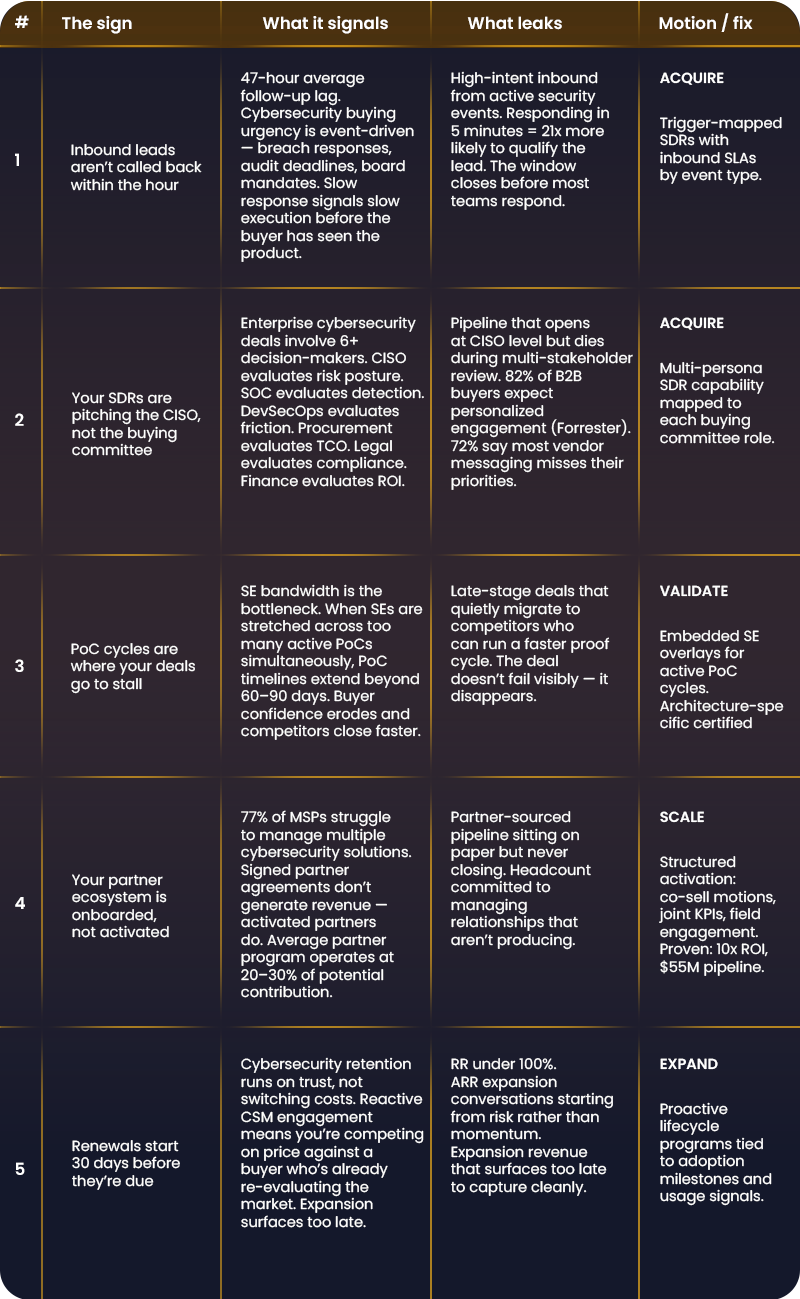
How many signs feel familiar?
-1.png?width=800&height=263&name=Table%201%20(1)-1.png)
The Structural Answer: Specialist Execution at the Stage You Need
Closing these gaps doesn't require rebuilding internal teams from scratch or outsourcing entire functions. It requires introducing specialist expertise where execution complexity is highest. Enterprise cybersecurity GTM demands different capabilities at different stages—from engaging a multi-stakeholder buying committee to accelerating proof-of-concept cycles, activating partner ecosystems, and driving long-term customer expansion. Applying the same generalist model across every stage often creates the execution gaps that slow momentum, delay decisions, and limit commercial outcomes.
MarketStar addresses these gaps by deploying specialist-led teams at the stage where they create the greatest commercial impact. For some organizations, that means embedding Sales Engineers to accelerate technical validation and reduce PoC timelines by 30–40 days.
For others, it's activating dormant MSSP and VAR ecosystems to generate predictable partner-sourced pipeline. Others strengthen buying committee engagement with multi-persona SDR teams that engage every stakeholder involved in the decision, not just the CISO.
The starting point depends on where execution is breaking down most. Rather than overhauling your GTM model, specialist capacity can be introduced where it delivers the greatest commercial impact.
What MarketStar's specialist execution delivers :
-
Faster engagement on high-intent, event-triggered cybersecurity lead generation opportunities
-
Targeted, persona-specific outreach mapped to each buying committee member
-
SE overlay support to strengthen cybersecurity presales, reduce PoC bottlenecks and accelerate deal progression
-
Structured channel partner ecosystem activation across MSSP, VAR, and reseller ecosystems
-
Proactive CSM engagement for renewals and ARR expansion
All of the above can be deployed independently or together. The right scope depends on where your execution gap sits.
About MarketStar
MarketStar operates cybersecurity sales and revenue execution programs for leading enterprise technology platforms. As a 2025 Everest Group PEAK Matrix® Leader in B2B Sales Services, MarketStar’s Sales-as-a-Service® model deploys cyber-native SDR, AE, SE, CSM, and Channel Specialist teams — structured around the specific stage of the revenue motion where execution is breaking down and aligned to whatever motion matters most right now.