
AI’s Role in Shaping B2B Enterprise Buying in 2026
The way enterprise buyers make decisions in 2026 has changed drastically from just a year ago. What once began with a search query or referral is now increasingly shaped by AEO and AI-driven discovery—long before sales enters the picture.
In fact, Gartner predicts traditional search engine volume will drop 25% by 2026 as users move to AI chatbots and virtual agents. This means discoverability depends less on ranking and more on showing up in the answers buyers consult first.
This shift is giving rise to Generative Engine Optimization (GEO)—the new standard for how brand value, expertise, and credibility show up in AI-generated responses. For revenue leaders, this raises a simple question: how is our value represented in the AI systems that influence discovery, comparison, and shortlisting—before a buyer even speaks to sales?
Discoverability Under Pressure: Four Shifts Leaders Can’t Ignore
Enterprise buyers are moving faster, expecting clarity earlier, and relying less on sellers to guide them. Together, these shifts are reshaping discoverability—and raising the stakes for execution.
1) Buyers want to self-serve—then validate fast
Buying groups are actively reducing seller dependency early in the process. Gartner found 61% of B2B buyers prefer a rep-free buying experience, and 73% avoid suppliers who send irrelevant outreach.
Implication: When early narratives are weak or inconsistent, buyers don’t wait. AI tools make it easier to move on—often before sales has a chance to engage.
2) AI is now a default research layer across the journey
Forrester reports 89% of B2B buyers have adopted generative AI, making it a primary source of self-guided research across buying stages.
Implication: Discoverability now shapes requirements, comparisons, and evaluation logic. The brand reflects what AI systems can corroborate—not just what companies claim.
3) More stakeholders means more risk of narrative drift
As buying decisions grow more complex, alignment becomes harder to maintain. Forrester research shows more than 80% of B2B buyers are dissatisfied with the provider they ultimately choose.
Implication: In enterprise deals, dissatisfaction is rarely about product failure. It’s expectation failure. When stakeholders encounter different versions of a story, alignment breaks—and AI can either reinforce consistency or amplify that fragmentation.
4) Digital discovery now carries enterprise-dollar stakes
McKinsey’s B2B Pulse found 39% of B2B buyers are willing to spend more than $500,000 per order through self-serve digital or remote interactions.
Implication: With enterprise spend moving through digital channels, AI has become an integral part of the buying journey. What it surfaces—and how it frames it—directly impacts conversion and velocity.
What This Means for Revenue Leaders
For CSOs, CROs, and RevOps leaders, early buyer interpretation shows up directly in the metrics you run your business on:
-
Pipeline quality: Evaluation shortlists form early—often without you.
-
Deal velocity: Early ambiguity slows consensus and approvals.
-
Forecast integrity: Expectation gaps trigger stalls or no-decisions.
-
Efficiency: Clear signals upfront reduce seller re-education.
That’s where GEO comes in—as a way to ensure your value is clearly represented in the AI-driven responses where buyers first decide who to consider.
A Framework for GEO Across the B2B Buyer Journey
To bring structure to those early decision moments, we analyzed how leading AI systems surface and reference brands across key buyer touchpoints. The result is a GEO framework that highlights where AI influences evaluation, comparison, and decision readiness across the buyer journey.
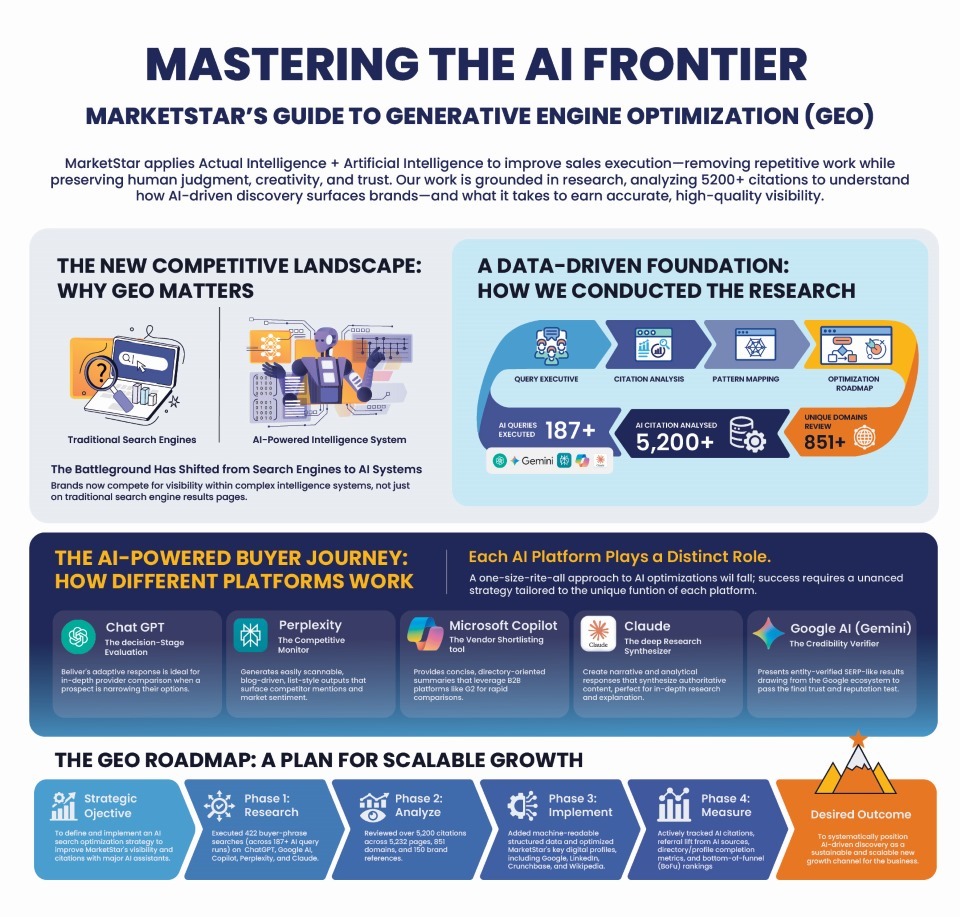
How MarketStar Operationalizes GEO Through Specialist-Led Execution
In enterprise buying, early buyer beliefs influence who gets considered, how risk is assessed, and whether momentum builds or stalls. This is where specialist-led execution matters.
In enterprise buying, early buyer beliefs influence who gets considered, how risk is assessed, and whether momentum builds or stalls. This is where specialist-led execution matters.
-
Clear ownership (not distributed accountability)
-
Specialist-led delivery aligned to enterprise buying dynamics
-
Governance so brand truth stays consistent across channels and stakeholders
-
Outcome ownership tied to revenue impact—not vanity metrics
Done right, GEO accelerates decision momentum across complex enterprise buying groups.
The New Standard: AI-Driven Discoverability for Enterprise Motions
In 2026, discoverability isn’t a marketing metric—it’s an execution lever. AI is shaping how buying groups interpret value, weigh risk, and narrow options before sales engages. The advantage goes to teams that stay clear, credible, and consistent across every early touchpoint.
MarketStar helps enterprise leaders navigate this shift through specialist-led GEO—built for governance, accountability, and measurable revenue outcomes. By treating AI-driven discoverability as part of the revenue operating model, MarketStar helps teams align signals, strengthen validation, and move buying groups forward with less friction.
FAQs
Q1. What’s the impact of AI-driven discoverability on enterprise buying today?
It shapes who gets considered before sales engages. AI influences early comparisons, risk signals, and shortlist formation—so inconsistent or weak visibility can reduce pipeline quality and slow decision cycles.
Q2. How is GEO different from SEO or AEO?
SEO optimizes rankings. AEO targets answer placement. GEO sits at the enterprise level, improving how your brand and expertise show up across AI discovery—so your value is clearly and consistently represented when buyers compare, validate, and narrow options.
Q3. Why does AI-driven discoverability matter more in enterprise deals?
Because enterprise decisions involve multiple stakeholders, higher risk, and longer cycles. When AI systems surface inconsistent or incomplete signals, misalignment spreads internally—slowing decisions or removing vendors from consideration altogether.
Q4. What breaks most GEO efforts inside large organizations?
Diffuse ownership and lack of governance. When discoverability is treated as a content exercise instead of a managed capability, narratives fragment across channels and sources, undermining credibility at the moments buyers seek validation.
Q5. What does “specialist-led GEO” look like in practice?
It means assigning clear responsibility to teams that understand enterprise buying dynamics, operate with governance, and are accountable to outcomes—such as clarity, validation, and decision momentum—not activity or content volume alone.