Enterprise AI adoption has entered a new phase in 2026. Leaders are no longer being measured on experimentation alone—they are being asked to deliver measurable AI ROI, improve seller productivity, and operationalize AI across increasingly complex sales organizations.
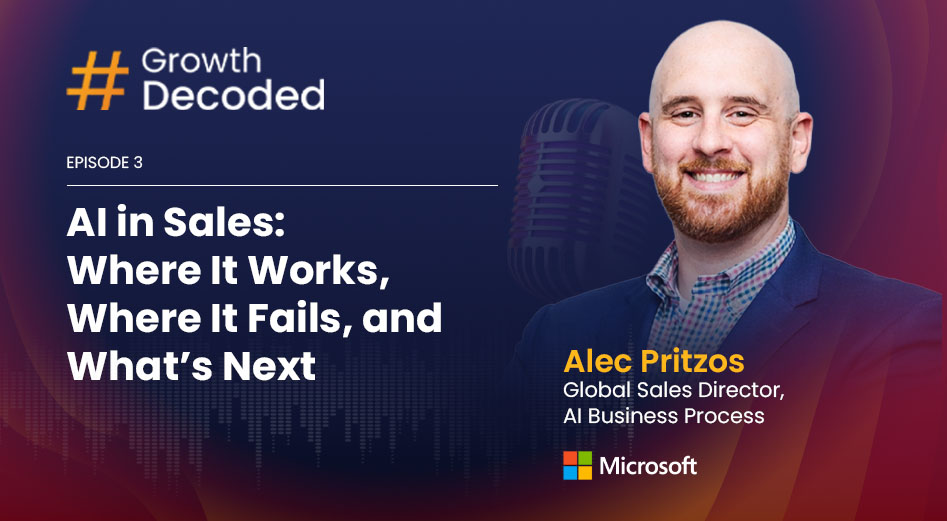
In this episode of Growth Decoded, Alec Pritzos, Global Sales Director for AI Business Process at Microsoft, joins Anthony E. Byrne, SVP of Global Business Development at MarketStar, to discuss what AI applications are actually driving measurable impact in enterprise B2B sales today. The conversation explores seller adoption, AI deployment challenges, workflow integration, CRM automation, pipeline analytics, and why the future of sales will be “augmented” rather than automated.
What AI Applications are Delivering Measurable Value in B2B Sales Today?
The clearest AI ROI in enterprise sales comes from three areas: meeting intelligence, account research, and pipeline analytics.
Meeting intelligence platforms are helping sales teams automate CRM updates, summarize conversations, capture next steps, and reduce administrative work for sellers. Alec is direct about where the industry is heading:
“If your sales team is entering data into a CRM system manually, then you're far, far behind.”
Account research is another high-impact use case because most B2B sales workflows begin with gathering customer intelligence, buying signals, and organizational context. AI-powered pipeline analytics is also improving forecasting accuracy and helping sales leaders identify deal risk earlier in the sales cycle.
Anthony notes that AI is also changing how GTM organizations operate by replacing slower quarterly reporting cycles with more real-time operational visibility.
Why Do Most AI Pilots Fail to Scale Beyond the Proof-of-concept Stage?
Many enterprise organizations think about AI deployment too narrowly—or too broadly. The operational effort required to deploy AI for a small group of sellers is often nearly identical to deploying it more broadly, which means many pilots consume time and budget without generating meaningful organizational learning.
He identifies three recurring challenges: fragmented workflows, poor data architecture, and low-seller adoption.
Alec also emphasizes that no single AI platform solves every workflow across sales, RevOps, and customer operations. Organizations often underestimate the complexity of integrating AI into existing systems and processes
Instead of running prolonged pilot programs, Alec recommends focusing on rapid proof-of-value deployments tied directly to measurable business outcomes like seller productivity, conversion improvement, and revenue impact.
What are the biggest operational challenges when deploying AI across a sales organization?
For most organizations, the biggest challenge is not the technology itself — it is organizational adoption.
Alec explains that seller resistance is one of the primary reasons AI initiatives stall:
“You can put all the tools out in the world, but if your sellers don't use those tools, it's not going to help.”
He shares that Microsoft experienced similar adoption challenges during its own rollout of agentic AI use cases. But once adoption crossed 80%, the business impact became measurable.
“Opportunity conversion [went] up about 15%. Revenue per seller when adoption went up was like 9 point something percent for us. It was pretty dramatic.”
The broader lesson is that AI success depends less on feature count and more on workflow consistency, enablement, process integration, and organizational trust.
Anthony adds that fragmented systems and disconnected data environments continue to slow enterprise AI deployment across many GTM organizations.
What’s the biggest misconception about AI in enterprise sales right now?
One of the biggest myths, according to Alec, is the belief that AI will replace salespeople entirely.
“It’s going to replace tasks. It’s never going to replace relationships.”
That distinction is becoming increasingly important in enterprise sales environments where trust, judgment, and customer relationships remain central to complex buying decisions.
AI can automate administrative work, improve forecasting, surface customer insights, and accelerate research workflows, but enterprise sales still depends heavily on human interpretation and relationship-building.
Anthony reinforces this point by specifying that enthusiasm, credibility, and the ability to connect business problems to outcomes remain fundamentally human capabilities.
The organizations succeeding with AI are not removing sellers from the process — they are redesigning workflows, so sellers spend more time engaging customers and less time managing operational overhead.
How close is AI to becoming a baseline expectation in enterprise sales?
The performance gap between AI leaders and laggards is already becoming visible.
Alec describes the future of sales in one word:
“Augmented.”
Leading organizations are already building custom AI workflows and internal automations that extend beyond out-of-the-box tooling, while others are still trying to operationalize foundational AI use cases.
At the executive level, expectations have also changed significantly. Anthony explains that leadership teams are no longer interested in AI experimentation for its own sake.
“The C-suite is not turned on by what you’re cooking or experimenting with. It’s what does it do? What’s it worth?”
That shift is accelerating the move from isolated pilots toward measurable operational execution tied directly to productivity, efficiency, and revenue growth.
What’s one piece of advice for CROs trying to cut through the AI noise?
Alec’s advice is simple: start smaller than you think
“Pick one workflow, measure the impact and then scale it from there.”
Rather than attempting to transform every workflow simultaneously, he recommends identifying a single operational problem, defining how success will be measured, proving value quickly, and then expanding incrementally.
As Alec puts it:
“How do you eat an elephant? One bite at a time.”
The enterprise sales organizations making the fastest progress with AI adoption are not necessarily deploying the highest number of tools. They are building repeatable systems for measuring impact, improving adoption, and scaling successful workflows over time.
Key Takeaways
-
Meeting intelligence, account research, and pipeline analytics are currently delivering some of the clearest measurable ROI in enterprise B2B sales.
-
Most AI pilots fail because of poor adoption, fragmented systems, and unclear operational ownership — not because of the technology itself.
-
Seller adoption matters more than tooling alone. Microsoft saw measurable gains in conversion and revenue per seller once AI adoption exceeded 80%.
-
AI is replacing repetitive sales tasks, but enterprise sales still depends heavily on human relationships, trust, and judgment.
-
In 2026, enterprise sales leaders are increasingly being measured on operational AI impact, workflow integration, and measurable revenue outcomes — not experimentation alone.