
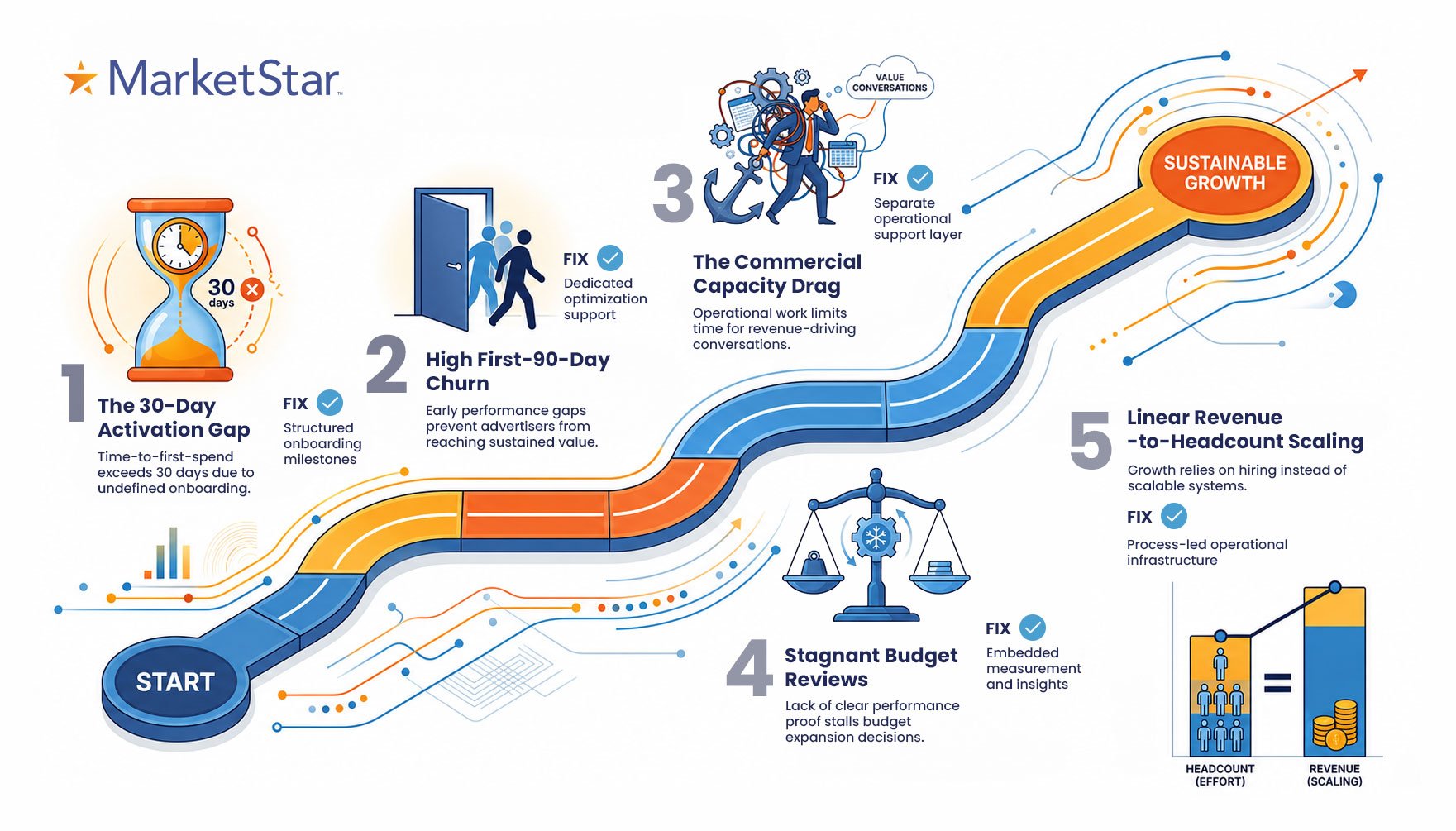
The strongest AdTech revenue operations programs are not built on a single breakthrough. They scale through consistent execution across a set of specific, repeatable commercial disciplines across the advertiser lifecycle—disciplines that, when working well together, compound into durable revenue growth.
This piece focuses on five operational signals that show up consistently in high-performing advertiser lifescycle management and advertising operations. Not as a theoretical framework, but observable patterns that directly impact advertiser revenue growth and the effectiveness of broader revenue growth strategies.
If several of these are recognizable, the stage where the signal is strongest is typically where execution of investment delivers the fastest return.
|
72% of marketers now prioritize cross-platform measurement—up from 64% the prior year (IAB 2026 Outlook Study)
|
66% of marketers say siloed execution wastes up to 30% of programmatic budgets (StackAdapt State of Programmatic Advertising 2026)
|
41% of large advertisers ($50M+) cite incrementality and cross-channel measurement as a top challenge (IAB 2026 Outlook Study)
|
Why These Signals Are Worth Paying Attention to Right Now
Three shifts are changing how ad-supported platforms must operate their advertiser revenue programs—and their interaction is what makes the signals below more consequential as programs scale.
1. Advertisers are under growing pressure to prove performance internally
Cross-platform measurement has become a top priority for nearly three quarters of marketers in 2026. That pressure shapes how advertisers evaluate and expand their platform spend—and it raises the bar for what account teams need to bring into renewal and expansion conversations. Causal proof of campaign impact has moved from a nice-to-have to a prerequisite for budget growth.
2. Execution fragmentation has a measurable cost
Two-thirds of marketers report that siloed execution wastes up to 30% of programmatic budgets. When account managers absorb operational tasks—reporting queries, troubleshooting, campaign setup—alongside commercial responsibilities, the drag on revenue capacity is real but rarely visible in any single metric. It shows up in aggregate, over time, as a ceiling on what the program can produce.
3. Execution complexity is growing faster than most internal teams anticipated
The advertiser base at most scaled platforms spans two fundamentally different commercial populations—a high-volume SMB segment that requires structured onboarding and ongoing optimization support, and a mid-market and enterprise segment that demands QBR-ready ROI narratives and measurement infrastructure operating across multiple stakeholders and budget cycles. The motions for each are different. The execution requirements for each are different. And the cost of conflating them—or under-resourcing either—shows up directly in activation rates, retention, and revenue per advertiser over time.
These shifts do not create the five signals below. They make each one more consequential—and more worth tracking—as the program scales.
Five Signals Worth Tracking in Any Advertiser Revenue Program
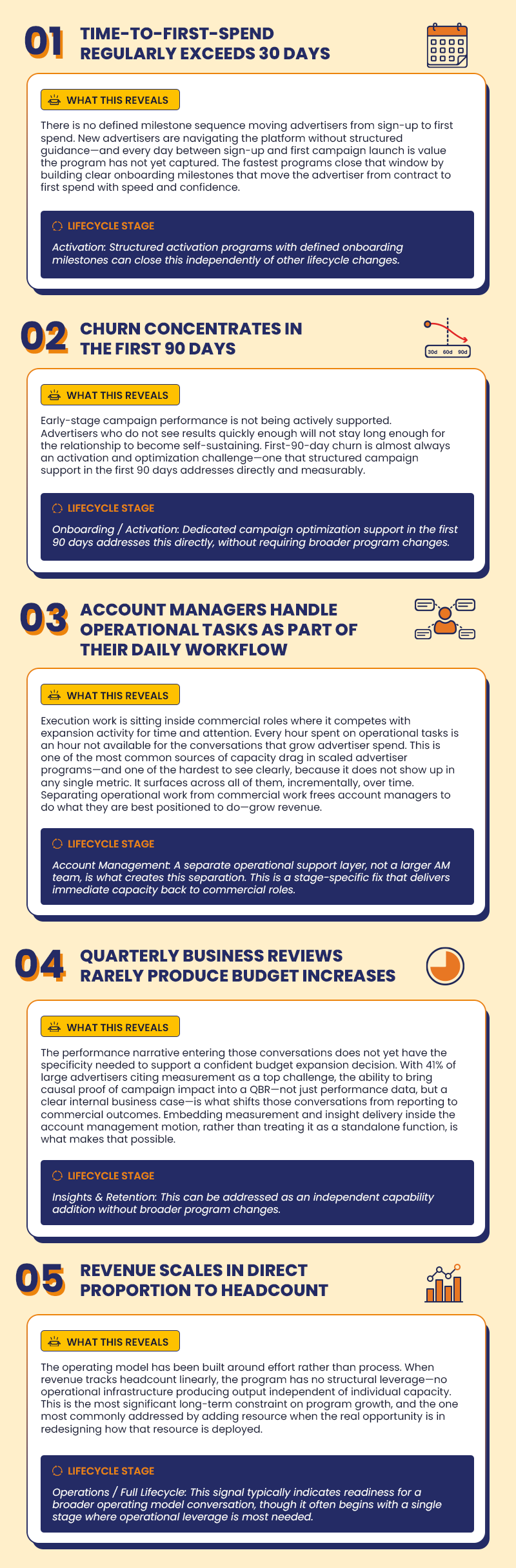
How to Score What You Found
| 0–2 Signals | 3–4 Signals | All 5 Signals |
|
Structural integrity is sound. Focus on optimizing individual stages rather than addressing system-level gaps. |
Execution gaps exist across multiple lifecycle stages. Each can be addressed individually—but where more than one is present, they are likely connected. A stage-specific fix delivers immediate value; a review of the broader lifecycle will show whether the gaps compound. |
The advertiser lifecycle has significant execution opportunities across multiple stages. This is typically where a broader operating model conversation produces the most meaningful commercial return—either stage by stage or as a connected motion. |
What Addressing These Signals Actually Changes
When these signals are addressed as a connected system rather than in isolation, the change is not incremental—it restructures how the entire advertiser revenue model functions.
Advertisers reach first spend faster, because onboarding has a defined structure rather than a passive one. Early churn falls, because performance in the first 90 days is actively managed. Account managers spend their time on commercial conversations, because the operational layer is separate and functional. QBRs produce budget expansion, because the performance narrative has been built to support that conversation. And the program grows without requiring proportional headcount increases, because the operational architecture has been designed to scale.
The common thread across all five is the same: execution treated as an integrated system rather than a set of independent functions. That design decision—made deliberately, at the program level—is what separates the platforms whose advertiser revenue compounds from those whose revenue tracks headcount and stalls when hiring slows.
As the advertiser base scales, the execution requirements at each lifecycle stage grow in complexity faster than most internal teams anticipate. The platforms sustaining performance consistently at scale are the ones bringing specialist execution to the stages where the commercial return on that investment is clearest—whether that is one stage or several, and whether they build it internally or bring in a specialist to run it.
About Marketstar
MarketStar operates advertiser sales, activation, and revenue enablement programs for leading global ad-supported platforms. Recognized as a 2025 Everest Group PEAK Matrix® Leader in B2B Sales Services, MarketStar's Sales-as-a-Service® model delivers consistent, scalable AdTech performance across the full revenue lifecycle.
Data Sources:
-
72% measurement priority and 41% incrementality challenge—IAB 2026 Outlook Study, January 2026
-
66% siloed execution waste—StackAdapt State of Programmatic Advertising 2026, based on 484 senior marketers and 6,000+ advertiser platform data points.
➤ Ready to turn strategy into execution?
Download the full infographic to review the five signals that can help you diagnose gaps and identify the highest-impact fixes across your advertiser lifecycle.



![How to Find High-Quality Leads [The AdTech Guide]](https://www.marketstar.com/hs-fs/hubfs/%282%29%20How%20to%20Find%20High%20Quality%20Leads.jpg?width=352&name=%282%29%20How%20to%20Find%20High%20Quality%20Leads.jpg)